Showing posts with label Nepal. Show all posts

Thursday, February 21, 2013

Nepal Photos

I've added a few new photos to the Langtang and Annapurna posts, and also uploaded a selection of Makalu and Everest photos, see below:

Trekking Part 1: Makalu Base Camp

Trekking Part 2: Everest

Trekking Part 3: Annapurna

Trekking Part 4: Langtang & Gosainkund


Friday, February 15, 2013

Trekking Part 4: Langtang

Well, against all odds, and despite the best efforts of the Himalayan winter, I've made it back from Nepal and home to Somerset in one piece.

Once JP arrived and we got permits sorted, we set off on the long bus journey up to Langtang National Park, up near the border with Tibet. The 8 hour ride was predictably hellish, and not helped by me throwing up so violently that I fainted, a slightly scary experience. Somewhat wobbly-leeged, we jumped ship at Dhunche, ready to start the trek in an alternative manner to the suggested route. First day was a big climb up to Sing Gompa, the highlight being a superb pair of Yellow-throated Martens that gave brilliant views near an army barracks at Dimphe. the forest below Sing Gompa was alive with birds, with Fire-tailed Sunbird, Himalayan Bluetail and Spot-winged Rosefinch being particularly nice. The hillside above SG was disappointingly empty on a quick 'warm-down' explore in the evening.
Yellow-throated Marten

Nutcracker

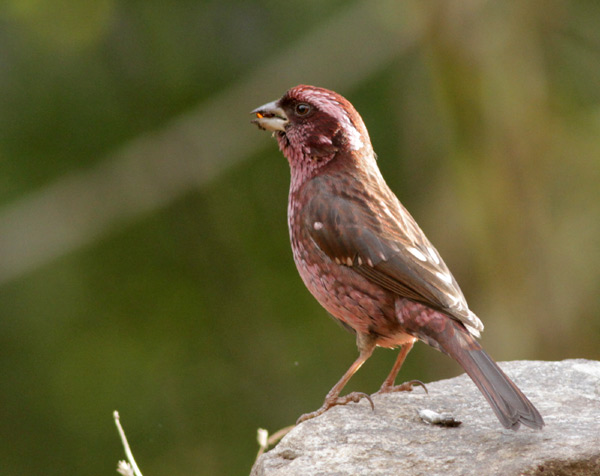
Spot-winged Rosefinch

To our great surprise, when we woke up the next morning, snow was falling heavily. Fortunately we were heading downhill that day so it wasn't too much of a worry as far as route finding was concerned. We hurried  on down to Thulo Syabru, and arrived just as the falling stuff turned into some really heavy rain. The bad weather seemed to have forced some things down the slopes and the fields around the village were alive with Green-backed Tit, OBP's, Plain-mountain Finch, and Plain-backed Thrush.
Plain-backed Thrush
Chesntut-tailed Minla

Long-tailed Shrike


The sky cleared the next day and we enjoyed beautiful sunshine over the next three days trekking up to Kyanjin Gompa at 3800m, with the avian highlights being a Maroon-backed Accentor in bamboo scrub just below Thulo Syabru, a flock of Grandala feeding in the snow above Ghora Tabela, and regular flybys from Lammergeiers.
Maroon-backed Accentor

Grandala

Lammergeier

 There was deep snow above Ghora Tabela, and Kyanjin Gompa was a totally different place to what it was 2 years before, it was absolutely stunning. An afternoon climb up to the 4600m Kyanjin Ri was well worth the effort (knee deep in snow with no trail to follow), rewarded by stunning views of the surrounding mountains and glaciers.


We trekked back down the valley, staying overnight at Renche, a much better stop than the favoured Lama Hotel, its position just up the slope giving it significantly more hours of sunshine. The next morning, we set off early and had been going less than 5 minutes when we rounded a corner in some bamboo scrub and BOOM, male SATYR TRAGOPAN, sat in the middle of the track. This stunning crimson, silver and blue pheasant locked eye contact for a few seconds, then head down, jumped off the path and down the steep slope. I dumped my rucksack and somewhat recklessly ploughed down the hill after it. Unsurprisingly, I didn't see the bird again, but that brief encounter was enough to make the whole trip worthwile. Satyr Tragopan has been the bird on top of my 'must see' list ever since I looked it up in the books after first hearing of it in Mark Cocker's 'Tales of a Tribe'. As an impressionable 16 year old whose most adventurous birding was probably the East Cliffs on Portland, reading the tragic tale of Alan Adams and his fatal quest for the Tragopan really opened my eyes to the lengths people went to in order to search out the best birds in the world, and inspired me to start planning for my first trip. Life has been rather interesting ever since.
Emotional as that brief moment was, the trek continued, and we we slogged back uphill to Sing Gompa. From there we were faced with the daunting prospect of crossing the Laurebina Pass, beyond the sacred lakes of Gosainkund. The Lonely Planet says something along these line about this leg of the trek 'the pass is dangerous after snow, and trekkers have perished here floundering in deep snow. If there has been heavy snowfall here recently, return to Dhunche'. Well, there had been heavy snow, but there was no way we were quitting now, mainly because we couldn't face the bus journey back to Kat, and we had met a couple of trekkers who had come over the pass in the opposite direction (though they told some pretty hair raising stories), so we decided to give it a crack.Starting early morning from the grim lodge at Laurebina, we trekked hard and fast up the hill, stopping only for a group of Snow Partridge, a quality lifer.
Hill Partridge

Snow Partridge

The lakes at Gosainkund were as spectacular as expected, and we were astonished to find a Sadhu living up there in the snow. I started thinking about how nuts religious folk can be for their beliefs, then realised that I was up there birding, not so different really. From Gosainkund up to the pass was tough, and I mean real tough. For the most of the time we were wading knee deep from snow, struggling to follow the tracks left by previous trekkers as they had been obliterated by wind, and climbing steeply all the time.
One of the easier sections of the pass traverse
It was a great relief to reach the pass, but the way down to Phedi was equally difficult going, and we were in quite the exhausted state when we finally rolled up late in the afternoon. From Phedi back to Kat was an absolute cake walk in comparison. And that was it, my winter in the himalays was over. After a couple of days kicking around Kathmandu and the near foothills, I returned back to rather soggy Somerset to try and work out what to do with my life. First priority is to be at Ham Wall early tomorrow for the reported Pied-billed Grebe, after that, who knows?

Saturday, January 12, 2013

Trekking part 3: Annapurna

The last month:
After returning to Kathmandu from the Khumbu, I met up with a group of the more intrepid members of my family who had come out for 3 weeks over christmas. We got our permits etc. sorted (fecking useles TIMS) then headed straight up to Pokhara and onto the Annapurna Base Camp trek. The bins stayed largely in the rucksack as I was mainly too busy keeping an eye on my nearest and dearest, so this wasn't a particularly birdy trek for me, but all the same I managed to see plenty of good stuff; Wallcreeper and Lammergeier were fairly regular (should've saved some cash and gone to the Pyrenees!).
Himalayan Langur


Wallcreeper


Scenically however, this was one of the best treks i've been on. All the way up, we were just getting fleeting glimpses of Macchapuchhre, Annapurna South and Hiunchuli through the clouds, but on the 'top day' we walked at dawn into the 'sanctuary' of base camp, and as the dawn rose a fantastic natural amphitheatre of peaks including Annapurna were illuminated in sunshine. A fresh layer of snow added to the atmosphere, you really had to be there, but hopefully my photos (to be uploaded when I finally return to the UK) will do the scene a degree of justice.
Annapurna South

Annapurna I

The Sanctuary at dawn
Exiting the sanctuary
On the way down we decided to add an extra day by detouring to Taadapani. This proved to be an excellent choice as it provided the best birding of the leg. The whole village was covered in thrushes, mainly White-collared Blackbird, which seemed to be feeding in every garden, ditch and field, but also a scattering of Black-throated Thrushes, Grey-winged Blackbird and best of all, half a dozen Chestnut Thrush, my first. Added to the mix were groups of stunning Collared Grosbeaks (Yellow and black has to be the best colour combo for birds!), and assorted rosefinches, tits, laughingthrushes etc.
Collared Grosbeak


Chestnut Thrush
Grey-winged Blackbird

White-collared Blackbird

 After the trek we headed down to Chitwan NP to warm up over christmas. Highlight was a SLOTH BEAR seen from the back of an elephant on christmas day!!, extreme close up views of Rhino whilst on foot (wait til you see the photos, unreal), Brown Fish Owl, Blue-beared Bee-eater and plenty of other birdy bits and bobs, but no lifers.
Blue-beared Bee Eater


Rhino a little too close for comfort (uncropped!)

After Chitwan I bade goodbye to my folks and returned to Annapurna for a solo circumnavigation of the masif, going the more difficult, and heavily advised against clockwise direction, why, I'm not sure, I think I just fancied the more difficult option just to make it interesting. The birding on this route was brilliant, starting in the lowlands, Slaty-backed Forktail and Crested Kingfisher were the riverine stars, followed shortly after by very tame wintering Ibisbills at Larjung.
Ibisbill

 Moving into the arid zone of south Mustang, Stolicska's Tit Warbler, Guldenstadts Redstart and Hill Pigeon were top class residents.
Guldenstadts Redstart

Hill Pigeon with Rock Doves

Crossing the Thorung La 'the wrong way' was always going to be one of the hardest days of the whole trip, and was no dissapointment on that front. Setting off at 4am, again, why so early i'm not sure, just thought it would be 'different' to do it by moonlight, it was one of the coldest days of my life. Shortly into the 4 hours it took to gain the top (5416m), my water bottle and packed breakfast had frozen solid, and my extremities were well on the way there too.
Blue Sheep on the Thorung La

On the top I was so cold I didn't even stop for a photo, just pegged it down to the sunny warmth of the other side, much to the astonishment of a trekking group and their sherpa who clearly hadn't expected to see anyone coming from Muktinath, let alone so early. After warming up I was feeling god so carried on all the way to Manang, trekking in 1 day what is recommended to take 3, no wonder I was slightly tired that evening!

Manang landscapes

Spotted Forktail

Great Barbet

The eastern half of the circuit was incredibly windy which didnt help birding so I fair flew down, all the way to Besisahar, and back to Kathmandu, where I am now. I'll be spending a little while recovering in the city while I await the arrival of Joe Parkes (who was my trekking buddy for my first trip out here 5 years ago) and then we're off to trek Langtang, Gosainkund and Helambu, for the final 3 weeks of my epic Nepali winter, and then its back to Somerset to sort my life out, and until when, this blog probably wont be updated.
See ya then!

Monday, December 10, 2012

Trekking Part 2: Everest

Once back in Tumlingtar, a week earlier than planned, I realised that I had a whole heap of time to spare, and that rather than follow my original plan of trekking up to Lukla, and then out to Jiri for a bus back to Kathmandu,  I had the option of punching North from Lukla and up into the Khumbu, Everest region, home of the Sherpa's, and the greatest mountains on Earth. To maximise my time in this mystical region however, I would have to get there quickly, so bins were stowed away in my backpack, and I absolutely missioned it through the lowlands (anything below 3000m is classed as lowlands in Nepal), and within a week I was at Namche Bazzar,  the gateway to Everest.
Looking up the valley on the trek up to Namche

Here the birding began in earnest. A 'rest' day in Namche to acclimatise had me chasing Himalayan Monals and Blood Pheasants up and down steep grassy slopes, eventually getting incredible views of these stunning species.
Monal

Blood Pheasant

 Top quality raptors were frequently seen, Golden Eagle and Himalayan Griffon Vulture patrolling the high ridges, and I even saw a Lammergeir overflying Namche from my Hotel room!
Himalayan Griffon and Taboche

After the agonising, upping and owning crossing passes between Tum and Namche, the trekking up here was a doddle, just gently following valleys uphill, gaining no more than 400metres a day to prevent AMS. By the time I arrived in Gokyo I felt really quite fresh and rested, despite being st 5000m, I had acclimatised well by now, and seen a whole heap of good birds on the way up, flocks of Grandala, the males an unbelievable plush blue velvet, Guldenstadts Redstart, hopping around the edge of a sacred lake (complete with resident Ruddy Shelduck), Alpine, Altai, Robin and Rufous-breasted Accentor strutting about like the pimped up Dunnocks they are, and Tibetan Snowcock feeding around village edges like chickens.
Altai Accentor

Tibetan Snowcock

Taboche Tso

The village of Macchermo, with Cho Oyu in the distance

And the moutains, oh, the mountains. There was always one particular peak dominating the skyline at any given time, changing as my perspective changed as I moved up the valley. First was Thamserku, then Ama Dablam (If Everest is 'mother goddess of earth' then Ama Dablam is her vindictive little sister, a real vicious looking mountain, put on this earth to kill people with too much of an adventurous streak), then Taboche, Cholatse, and up above Gokyo, the mighty ice wall of Cho Oyo. Trekking up the valley from Gokyo was a spectacular way to spend an afternoon, culminating in my first close (relatively speaking) views of Everest from 'scoundrels viewpoint' above the sacred lakes, where I filled my water bottle with ice-cold water, milky with sediment eroded from these great peaks.
Hunchhi from the top end of the Ngozumpa Glacier

Sunrise over Kantega


Thar she is!! Everst, Sagarmartha, Chomolongma, Mother Goddess of Earth, whatever you wants to call it. Probably as close as i'll ever get. It was nuts to think that was still another 3,800m up from where I was looking!

Ama Dablam at dusk

Looking across the Ngozumpa Glacier to Cholatse, just before I had to pick my way across the moraine. It was as tricky as it looks

From Gokyo came what was always going to be a tough trek over the Cho La, a 5460m pass complete with glacier. Knowing that, as an ice-novice, traversing the glacier alone would be silly, borderline reckless, I gave myself a lie-in to allow the couple of groups staying in the same village as me, a chance to get there first and their guides to make out the path over. 2 hours I gave them but after just 90 minutes trekking I had overtaken them, they just trekked too damn slow, even with porters carrying their heavy gear. So as it was, I was first man up to the pass that morning, with a beautiful, pristine looking glacier to negotiate. Sod it, how hard can it be I thought, and pressed ahead. Really flipping hard it turns out. After just a few minutes I found myself off the crisp, grippy snow and on clear, blue ice, slippy as hell as the morning sun warmed it. I knew I was in a bad bad place, but I was too far to turn back and I thought that if I took it easy I could make it over. Next thing I knew I was on my arse and sliding downhill at gathering speed, I was desperately trying to perform a fingertip self-arrest but the ice was too smooth, I was rocketing downhill at a hell of a rate, towards the big icefall at the end of the glacier . Suddenly, SMACK, a large, conveniently placed, and very painful lump of ice slowed my descent and I managed to grab hold of some icy ridges. From there, a quick shaky scramble saw me safely on the right side of the glacier. It had all happened a bit too fast to be scared, but looking back, lets just say I was in quite a spot of bother, probably the worst situation i've been in in all my travels, and thats saying something!
The views from the Cho La


I took this self portrait just before my 'little slip'. Check out the angle of that ice, then imagine sliding down it with a 20kg pack on, fun times!


After that experience, I hurried down to gentler slopes, but 2 days later found myself climbing up to Chhukung Ri, at 5546m, a 'personal best' for altitude, and with stunning views up at Lhotse and Nuptse, and down at their respective glaciers, with a novel new view of the backside of Ama Dablam.
The Nuptse ridge from Gokyo Ri

Ama Dablam, Nuptse and Lhotse
Downhill back to Namche I stopped 2 days at Tengboche, with its famed monastery, but to be honest, I wasn't all that impressed with this much acclaimed place. Back to Namche it was for more pheasant watching, and then down to Lukla, where the weather had me stuck for a few days waiting for a plane out. Eventually, I was booked onto the first flight of the day, and I was waiting nervously at the airport gates at dawn under clear skies. After a delay due to flog at KTM, the plane, a tiny old Dornier eventually made it in and we were hurried onto the tarmac and up into the tiny aircraft. The reason for the hurry became apparent as we rocketed down the runway and over the cliff edge before rising up into the valley, a massive bank of cloud was piling up towards us from the lowlands. We ploughed through it, and after an hour I stood relieved in the haze of Kathmandu, possibly the only flight to make it out that day!
White-winged Grosbeak

White-throated Redstart

Himalayan Tahr

Well thats me up to date from Nepal, for now. Tomorrow i'm off to Pokhara to start it all over again in the Annapurna region. There will be more hastily written nonsense when I return in god-knows-how-many weeks. I should probably take this opportunity to wish you a Happy Christmas, and a bird (or whatever it is that interests you) filled New Year. Cheers