Sunday, May 08, 2011

Levelling

After getting back from Malta it was back to the Somerset Levels for a few days birding with my Dad, which yet again produced the goods. After being picked up from the airport early afternoon, conventional logic would have suggested having a nap, as an average of 5 hours sleep a night on Springwatch had left me totally drained. However, it just felt a bit 'birdy' so after a quick lunch we headed down to Shapwick, the journey down being hurried by breaking news that a Wood Sandpiper that had been on the drained pool for the last few days had been re-identified as a Lesser Yellowlegs, a mega bird for Somerset. Sure enough, when we arrived this leggy transatlantic vagrant was pottering around the pool already with a decent sized crowd of admirers. It never came very close and this was the best shot I managed in several visits over a few days.


Rare as it was, the 'legs couldn't quite compete with this absolute stunner of a bird. I've never seen Great White Egret in breeding plumage, so it awesome to see this colourful beast fishing and flying about the same pool, check out the colours on the tibia and the lores, it's frickin glowing!!


Come at me bro'!!

The place was alive with birds as ever, and very noisy too. Cuckoos were flying around all over the place, phyllosc, sylvia and acro warblers singing from every bush, Bitterns booming and Hobbies and Marsh Harriers constantly overhead, excellent birding.


That evening I was in the mood for finding a Night Heron (we've all been there at some point) so after dinner we were just picking up our stuff to head back for a quick look when the news came through that a Gull-billed Tern was over Noah's Lake. I'm not gonna lie, I wasn't best happy. When a bird as good as that gets found at a site that you're just on your way over too, it's difficult to not feel a bit 'gazumped', especially after almost the same scenario with the Yellowlegs earlier in the day. Still, it was another great bird for Somerset so we hastened on down and got good views of the bird hawking for c20 minutes before it naffed off high to the South, never to be seen again. It was a bit dark for photography but the following just about qualify as 'record shots'.


It was back down to Shapwick first thing the next morning to see if the previous days stars were still around and if anything else new had arrived. The Leeser Yellowlegs was still showing nicely in the same spot, and the drained pool also attractd in a drake Garganey, and briefly resting Whimbrel, Ruff and Little-ringed Plover alongside the constantly turning over squabbling flock of Black-tailed Godwits.


If you're not seeing the sun like this then you need to man up and get out of bed earlier


One of the ubiquitous singing Blackcaps


It'll be a sad day when I can walk past one of these bad boys without taking a photo


After the horrors of Malta it was a delight to see Marsh Harriers safely going about their business


The next day morning was just as good, with a majical highlight being two Bitterns circling high over the reedbeds just as the dawn broke. With the crisp, still air, the soft sunlight starting to break through a light mist and the cuckoos and all the warblers singing in the background, this was a really evocative moment, and for me summed what The Levels are all about. I took a few photos but they don't do the moment justice at all, so I won't post them here, you'll just have to go experience it for yourself.


I dont like to end on a sour note but you really should check out the latest awful news from Malta here. Frickin Pallid Harrier!! Where does this shit end!!


Sunday, May 01, 2011

Springwatch Malta 2011


From 10th-20th April I took part in the Birdlife Malta Springwatch 2011 camp. The situation in Malta and the purpose of Springwatch has been covered by many pieces with much more depth, accuracy and eloquence than I could hope to achieve here ( This page gives the best overview of the situation, and be sure to listen to the podcast linked in at the bottom of the page)so for this trip report, I will focus instead on what YOU can do to help.

I’m sure that many of you previously aware of the hunting problem have already donated to Birdlife Malta, signed petitions, and written to MP’s, and I implore you to keep doing so. This has clearly had the effect of applying external pressure to the EU and the Maltese Government, encouraging such actions as not opening a Spring hunting season in 2008 or 2009, which had the immediate effect of allowing a fantastic breeding season for the birds of Malta, as well as providing a certain level of protection to countless migrants on their journey North. However, despite this pressure, the Maltese Government defied the European Union by opening Spring Hunting again in 2010 and 2011. Given the dismal lack of resources allocated to the Maltese Police to ensure that the conditions of the hunting season are followed, it is necessary for Birdlife Malta teams to act as observers, and as you may have guessed, this is what this post is about.

Birdlife teams of 3-5 people spread out across the island during the ‘danger’ periods of dawn and dusk, armed with optics and video cameras and a direct line to mobile police units. During previous camps, teams have managed to obtain footage of illegalities being committed, which has led to several convictions. This has had the predicted effect of making hunters very wary of breaking the law whilst in view of a Birdlife team. During the 10 days that I was on the camp I saw just one raptor being killed. A Marsh Harrier leaving a roost at dawn was shot down as it was gaining height to continue its journey North to its breeding grounds. This was a horrible moment for me. We were on site to protect that bird and we failed, the moment I saw it hit, I felt like I had been punched in the stomach, it was sickening. What made matters worse was that it was too dark to be using the video cameras, and we didn’t see where the bird fell, basically, we had no evidence that the incident ever happened. Still, we called the police immediately, and they responded admirably, with 2 patrol cars on site within 10 minutes. By this time, the hunters in the area had become aware of our presence, and 4 more birds left the roost safely. I think it is fair to say that had we not been on site that morning, it would have been more than that 1 bird that died. This was the general feel throughout the camp, that the hunters knew where we were (they had ‘spotters’, and were in radio contact alerting each other to our presence), and so, were unwilling to shoot protected birds in front of us, in case they got caught.


A fine case of 'Malta moult' on this Marsh Harrier

Of course, this is far from an ideal scenario. Birdlife teams can only cover a certain, small proportion of Malta, limited as they are by the number of volunteers attending the camp. This is where you come in. By coming on a future camp you can make up the numbers to allow Birdlife Malta to send extra teams out into the field, thus covering more areas, and providing a good deal of protection to any birds passing through those areas. The next camp is the Raptor Camp 2011, running during the last two weeks of September. This is a plea for you to be there.

So, what is the camp actually like? Well, I absolutely loved it. Aside from the expected low points upon seeing a bird getting shot, I thoroughly enjoyed every minute. The hotel was comfortable and clean, with decent, plentiful food. The general atmosphere was great, with plenty of banter keeping spirits up despite witnessing some terrible things. It was a privilege to work alongside some fantastic inspirational people, both from Birdlife Malta Staff and camp attendees.

The surveillance sessions themselves were quite variable. A few times the fine weather meant that migrants were simply not present, and so there was no hunting activity to record. Generally though, we were kept busy, with illegalities taking place almost constantly. Most frequently, it was a case of shots being fired outside of legal hours, recording sightings of birds bearing gunshot injuries, hunters not wearing the compulsory orange armbands, use of illegally modified shotguns firing more than 3 shots, and of course, the occasional instance of shooting at protected species. As well as recording all of this and alerting the police if necessary, the major work involved was using the video cameras to film any large bird constantly while it was in view, so that if it was shot, we would have proof of the incident. Also recording numbers of all migrants passing through is a key role for teams, as Malta is on a major migration route, and as such deserves monitoring . Standard watches are run from shortly before dawn until about 8am, and then from 3pm until dark. If there are roosts or movements of birds deemed to be at risk outside of these hours then volunteers can go and watch over these birds (this is optional, as obviously people need rest). I did a few night watches over Harrier roosts, which turned out to be fairly uneventful, though still exciting!

I know that personal safety is an issue that deters many birders from visiting Malta. It is true that there have been some shocking incidents in the past. Local birders have been threatened, verbally abused, beaten-up and had vehicles and optics destroyed. However, the bad publicity caused by such aggression has seriously tarnished the hunters reputation in Malta, and they are aware of this. During my time in the camp, ¬one team received 30 minutes of abuse, and bit of chest-shoving from 2 particularly aggrieved hunters, but this was the only incident of any note. Personally, I only had one face-to-face encounter with hunters, and that was a very civilised, quiet debate, and at the end we simply agreed to disagree. I never felt threatened in any way, and I don’t think anyone else on the camp did either. Bear in mind though, that being treated to verbal abuse is a strong possibility, and if you’re the kind of person who would be overly upset by this, then maybe the camp isn’t for you.

The birding was good, with a daily passage of Common and Lesser Kestrels, Hobbies, Marsh and Montagu’s Harriers, and a few Pallid Harriers and Black Kites. Herons featured too, with some big flocks of Purple, Squacco and Night Herons. Other typical Mediterranean species were also easily seen, mainly Golden Oriole, Bee-eater, Black-eared Wheatear Red-rumped Swallow, Pallid Swift, Woodchat Shrike and Blue Rock Thrush. We did have one session that ranks as one of my best birding moments ever. On our afternoon shift at Mosta Gardens, strengthening North-easterlies and some heavy rain forced in a spectacular arrival of 110 Marsh Harriers, 40 Montagu’s Harriers, 1 Pallid Harrier and 60 Lesser Kestrels!! Add to this 2 male Golden Orioles and 42 Bee-eaters hanging around us and I was left pretty gobsmacked. It was apparently a slow spring for passerines and I was quite disappointed with just a few Wood Warblers, Pied Flycatchers and a single Eastern Subalpine Warbler. These are just my personal sightings mind, and such crackers as Roller, Red-footed and Eleonoras Falcons, Collared Flycatcher, Little Crake, and Little Bittern were recorded by other teams. I should also mention that Autumn passage is much bigger than in Spring on Malta, and I have heard some gripping tales of flocks of Short-toed Eagles and Black Storks battling through hordes of Honey Buzzards on their way South, so I can’t imagine anyone being bored by the birding in September.


I expect Birdlife Malta to announce details and dates of Raptor Camp 2011 on the website before the end of May, and I will post again on here when they do, until then, watch a few videos, read some articles and convince yourself to go.

Finally, all I can say is that I would definitely recommend attending a camp. I will be back for as many as I can in the future, including almost certainly the Raptor Camp this Autumn. It may at times be tough, but you will have some great birding, meet legendary people, and most of all, play a major part in protecting Europes finest birdlife. If any further encouragement is needed, watch this, and see what we’re working to prevent. Thankyou.


Oh yeh, and if you're thinking about it, feel free to ask me any questions, as a comment on here, by e-mail or stop me for a chat if you have the misfortune to bump into me in the field.

Sunday, April 03, 2011

Karma Strikes Early

This time yesterday I was roundly cursing the birding gods for forsaking me by producing a Red-flanked Bluetail at Durlston, just down the road from my student house in Bournemouth, a mere 18 hours after I had left Dorset for the Easter holidays. I had made what was looking like a shocking decision to head up to Somerset for a few days birding on the Levels with my Dad, before a starting a weeks work tomorrow, and the Dorset departure was looking like a bad move: I still 'need' RFB for Britain, and indeed the world if they're split from the Himalyan birds. There's not many things that i'll twitch these days, but that would certainly have been on the cards, being so close to 'home'. Still, it wasnt going to stop us birding the levels and this morning had been most pleasant, with a whole heap of migrant year ticks; LRP, Ruff, Willow Warblers, Sand Martins, and best of all 2 Swallows, my favourite of all our native birds. Just five minutes from getting back to the car for the last time before departing for East Somerset, we noticed a large bird passing distantly through a gap in the trees, clearly wasn't a heron, bins up and another glimpse before disappearing behind the trees again- BLACK STORK!!!!!! SHIIIIIT!!!!! (wholly accurate representation of the ensuing conservation). The bird looked to be simply heading away behind more trees when it decided to turn around, circle twice and then carry on drifting low North-east, giving us just enough time to get some nice views and blast off a few record shots. Unfortunately my camera, unused for several weeks had switched itself to some horrendous setting and my first shots, of the bird at its closest were overblown something rotten. Luckily, a bird that big manages to burn itself onto a sensor despite the photographers ineptitude and I got the following 'souvenirs':
 
And what's all that about Karma? I hear you cry. Well, on the 10th April i'm off volunteering in Malta with Birdlife at their Springwatch Camp to do my very best to protect migrant birds from being shot indiscriminately. Anyone who watches 'My Name is Earl'-one of the few watchable programs on E4, will know that if you do good things, good things happen back to you. I like to see this as Nature's reward for my upcoming trip. The moral of the story, if you want to find as many good birds as I do (smug much?) do you some volunteering, not neccessarily in Malta, try the RSPB, or your local Wildlife Trust, you never know, it could pay off!

Sunday, February 06, 2011

Twitchers in Poole Park

Two posts in two days, that is unprecedented productivity for this blog. Anyway, I have this amzing little gadget that tells me how people arrived at this blog, and over the past few days i've had a fair few hits from people googling 'Twitchers in Poole Park'. Now, being a birder living in Poole, the words twitcher, poole and park appear frequently throughout the blog, just not in relation to these queries, ironically really, as I happen to have been one of the twitchers in question.
And this is why, a Long-billed Dowitcher, a vagrant from North America, hatched up in the Arctic tundra last summer, accidentally flew East over the Atlantic on it's migration South last autumn, and after a winter dithering around Western Europe has somehow ended up in Poole Park, and finds it very much to its likeing, feeding just metres away from an admiring crowd of birders and curious passer-bys.
Astonishingly, over the last two days there has also been a Ring-billed Gull, another American vagrant, but I haven't seen it yet so can't share any photos, there are a few here if you're interested though, grotty looking thig if you ask me.

POLITICAL INTERLUDE!!While you're here, take some time to whip over to the 38 degrees site and sign the petition to save our forests if you haven't already, cheers!
Then check this witty (though a little rude, you have been warned!!) song by Frank Turner, who i've wangled tickets to go see in the Students Union in a few weeks. Hits home a little too hard given the current government 'firesale' eh!!

Saturday, February 05, 2011

Nepal photos

About a month ago I returned from a family christmas to the fantastic country that is Nepal. I had a few interesting sightings, so in the near future I should get around to writing up a proper trip report, but in the mean time, here's a brief taster of how it went.

After a few days settling into Kathmandu and seeing the usual touristy sights, we set off on a trek up the Langtang Valley. Seeing as how I was leading the family, it was difficult to do much full on birding, but I managed a few lifers, including some birds of top-class quality, and as expected, a glittering supporting cast of local goodies.


Long-billed Thrush- Lama Hotel


White-capped Water Redstart- Ubiquitous along the river


Hoary-throated Barwing-Rimche


Golden Eagle and Lammergeier above Kyanjin Gompa. Truly awesome sight


The same Lammergeier as above


Ashy-throated Warbler- Rimche


Appalling photo of the bird of the trip- Himalayan Monal, just above Langtang village. Watching the morning sun glittering off this stunning National Bird of Nepal as it fed on the mountainside was one of the highlights of my birding life so far.


Peregrine Falcon (peregrinator?) taking a breather from chasing Snow Pigeons around Mundu
Snow Pigeons taking a breather from being chased around Mundu by a Peregrine Falcon

Other highlights of the trek included Little and Spotted Forktail, Rufous-fronted Tit, White-throated, Guldenstadts and Blue-capped Redstart, Rufous-breasted Accentor, Spotted Laughingthrush and Black-faced Warbler.
Immediately after returning to Kathmandu we headed down to Chitwan National Park for the remainder of the trip. Unsurprisingly, highlight of our time here was an astonishingly close encounter with 2 Asian Rhinocerous (from the safety of the back of an elephant, unlike my previous visit to Chitwan). The only lifer for me in the park was White-rumped Needletail, but again, there were plenty of commoner local birds to enjoy, frequently at close range.
Grey-backed Shrike
Indian Pond Heron

Pied Kingfisher


Great Hornbill- the sight (and sound) of these beasts passing over a rainforest canopy is one of the many experiences that make Oriental birding so special.
Taiga Flycatcher

For more typical holiday photos, this link should take you to my Facebook album of the trip

Tuesday, December 14, 2010

Update!!

Sooo, blog not updated for several months, pretty much standard for me.
Basically, i've not done any birding to report on. I've just been too busy at uni with, errr, assignments, yes that'll do, i've been doing assignments all autumn/winter.
I have however found the time for some volunteering with the Dorset Wildlife Trust, which has it's many rewards, such as this Little Auk whichwas sat off the landing stage upon arrival at Brownsea Island a few weeks ago.


Excuse the shite picture, digibinned with a naff little compact from a moving boat!!

I finished uni for the year on friday and since then i've had a few days birding the Somerset Levels. I haven't looked around the levels properly for about 10 years or so, so I was surprised and very impressed to see how the reserves have come along there. The area of land now setaside for conservation around the shapwick/westhay area has increased massively and theres new paths everywhere, well done to the organisations involved. It was all pretty birdy too, with Bitterns and Cetti's Warblers in particular seemingly all over the place. Highlight however was watching 3 Otters at close range feeding along a frozen drove, pure magic.


Anyway, any recent sightings will pale into insignificance with what i'll be seeing over the next few weeks. After a long period of no travelling i'm finally back on the road, with a 3 week trip to Nepal beginning tommorrow. It's a family holiday so won't involve the usual reckless pursuit of exotic rares, but should still be good fun. There will of course be pictures galore and hopefully a trip report (if I can find the time away from those pesky 'assignments') when I get back. Until then, a Merry Christmas and Happy New Year to everyone.

Tuesday, September 28, 2010

Small Compensation

Missing the Point, MISSING THE POINT!!! Shit.
How prophetic those words turned out to be. 9 days after I leave and the lads go and find an empidonax flycatcher. OK, so its not the first for the WP Yellow-bellied that it was first put out as, but anyone who knows how dangerously obsessed I am with finding rares can imagine just how devastated I was when I heard the news.
At that point I realised that I had two options; to crawl into a corner and spend the rest of the autumn crying, or to bird my ass off for the rest of the season and try and find a rarity to match it, however unlikely that would be. Obviously the second option is much more appealing, and aside from spending Sunday volunteering down at Studland with the National Trust, i've been mostly birding during daylight hours. Hengistbury Head has been the site of choice of site for the last 2 days, and was particularly enjoyable today, as I found a Wryneck up on the heath on Warren Hill. Small beer indeed compared to the recent fare on Blakeney but its always nice to find something unexpected and is exactly the sort of thing I need to give me the motivation to keep getting out there over the coming weeks.
Back to the horrible beast that is the empid, I can only repeat what I said about the cornish bird at the time. Willow and Alder are pretty much impossible to seperate. We banded plenty of empids in Canada, Least and Yellow-bellied are pretty straightforward, but even in the hand, Willow and Alder just went down as 'Traills'. There are supposedly methods of seperating the two using biometrics but we tried them and they all turned out to be inconclusive. OK, so Alder is much more likely on probability but what sort of Rarities Comitee adds a species to a National List based on probability. As many people have suggested already, I think the best bet is to just recognise the birds as Traill's Flycatcher and hope that soon some clever bod comes up with a way of separating the two conclusively.
Anyway, and most importantly, massive congratulations to James and Paul for finding the bird. As all the twitchers who visited the point over the weekend will attest too, it is an absolute bitch of a place to bird. Imagine doing that walk pretty much every day over the course of the autumn! This find was a monumental reward for a monumental effort, top marks to the lads, you deserve all the glory you get, and I say that with only a smidgen of the bitterest jealousy.


Wryneck at Hengistbury


One of many very tame Stonechats


Ring Ouzel record shot


Another one of the Wryneck


Friday, September 24, 2010

Missing the Point

Having left Blakeney Point last week, i'm back in Dorset for my second year at Bournemouth Uni. Mylast few weeks up in Norfolk were pretty awesome, providing some of the most challenging, yet rewarding birding of my life. Although we had no more rares after the Booted Warbler in the last post, a constant stream of classic scarcities, and good numbers of common migrants combined to make it feel like the good ol' days of the '70s. As this was my first season on the Point, I feel extremely lucky to have been present for what the locals are calling the best August for decades. Here's just a few of the little gems that made all the suaeda bashing worthwile:


Redstart


Bluethroat- 1 of 3 seen in a week, and I think before any others had been seen elsewhere in the country!!


Wryneck


Spotted Flycatcher- ticked by one happy visitor as the bird below, jesus wept!!


Barred Warbler


Lapland Bunting. This was the first bird to be seen in England and possibly the UK this autumn, and appears to be spearheading an impressive invasion.

Friday, August 27, 2010

Bootiful Day

You're probably thinking something along the lines of "What!! Joe's Birding Blog has been updated, that can only meant that he's found something rare and wants to brag about it to anyone who cares to listen"

Well, thats pretty much spot on. Autumn on Blakeney Point has been absolutely brilliant. With 2 Icterine Warblers, a Barred Warbler, a Marsh Warbler and a Bluethroat over the last few weeks making this August the best for a long old time.
Searching for the Bluethroat this morning, we were delighted to find a Lapland Bunting, the earliest record ever for The Point. We were pretty chuffed with this and assumed it would be taking the 'bird of the day' slot.
A last gasp tramp around the Long Hills soon trumped this however, when we flushed a small, sandy warbler with white outer tail feathers from the suaeda. Logic decreed that such a bird could only be a Booted or Sykes's Warbler, and soon enough the bird jumped up onto the suaeda tops, showing off its short bill, relatively strong head pattern and contrasty tertials, definately a Booted Warbler, GET IN!!!!!!

The bird proved to be very elusive and mainly only gave flight views, though it did perch up a few times, giving some reasonable looks to the few birders who came along to see it.


My best attempt, possibly qualifiable as a record shot?! This shot is pretty typical of the views we got.


The Lapland Bunting on Far Point


Barred Warbler from a while back.


One of a good number of Pied Flycatchers so far this autumn.


I dont generally twitch these days, but this Lesser Grey Shrike at Kelling made a nice day trip for me and a visiting birding friend from Canada with the excuse that he needed it for his world list.
On a totally different topic. I have managed to totally break my phone recently (too much birding in the rain in), and having recently lost most of my e-mail contacts, and Facebook being blocked on the work internet server I use, I am pretty much un-contactable with the outside world. If you're a friend of mine and want my new number, or think I ought to have yours, just drop an e-mail to my usual address.

Monday, May 31, 2010

BOOM!!!!!

You slave away all spring, you trek back and forth over every dune, you slog through every yard of sueada, you peer into every bramble, and you see naff all. Just one thought keeps you going- It only takes one moment, just one bird.
And as Spring fades into Summer, you start to think, will that moment come, has it happened already, and slid away unnoticed, has it....., but you carry on.
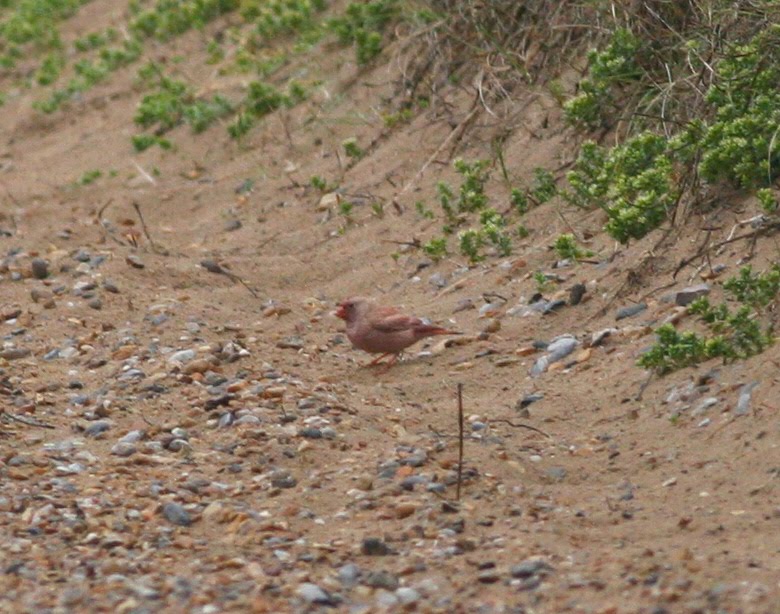
And then, just as you start to lose hope, and just as you least expect it, as you're yakking away on the phone, you glance out of the window, and KA-POW, a pale thing with pink bits on it flits past, and you remember that feeling, the feeling that just has no equal, and it all becomes worthwhile.

Wednesday, March 03, 2010

Fair Weather Birder

After a lengthy period of gross inactivity I was finally lured out yesterday by the glorious weather and the imminent onset of spring. A trip across the harbour to Studland was the order of the day and turned out to be very pleasant indeed.
With a total lack of wind, the bay was mirror calm and produced decent counts of 18 Black-necked and 4 Slavonian Grebes, along with a Common Seal, which I think might be a Dorset mammal tick for me.


Slavonian Grebe


Black-necked Grebe

I should have been getting angry at this beast scaring the grebes but I was too busy drooling with jealousy and trying to work out a way I could get my hands on one. I'm still thinking.


One of five Purple Sands on the rocks at Sandbanks, typically confiding.
My first proper spring migrant came earlier this afternoon as I took a run along Poole seafront and spotted a Sandwich Tern roosting with the block-headed gulls on Baiter Park, spring truly is on!!!!
I've got plenty to look forward to at the moment, first up being a ski trip to France next week with the my university TA unit which should be cool, hopefully i'll find time to digibin a few snowfiches and alpine accentors.
Most exciting however, is that I've got a job on Blakeney Point, Norfolk, for the summer. I'll be starting early April and that will see me returning to a more pro-active state of birding, and hopefully i'll manage to find a few goodies during my time there. I really can't wait to get properly 'back in the game' again, once you've lived on site at some migrant hotspot like that, its impossible to be totally happy when you're not!!!

Wednesday, February 10, 2010

First attempt at blogging a video

After a promising start to the year i've turned lazy again. Apart from turning my head towards the shoreline whilst jogging along the front at Baiter park i've not been birding at all. Still, the starling roost in Poole has been good value. This evenings gathering wasnt particualrly impressive numbers wise, but there were a few cool little manoueveres and I happened to have nothing else to do at the time so thought i'd try out the video functionon my digital compact on them. this was shot from my bedroom window a few minutes ago.